

Automated patient follow-up without patient-facing AI
Automate welcome texts, weekly check-ins, and running-low reminders with clinic-approved copy. No chatbot. Staff step in when a reply needs a person.

· 4 min read · Updated
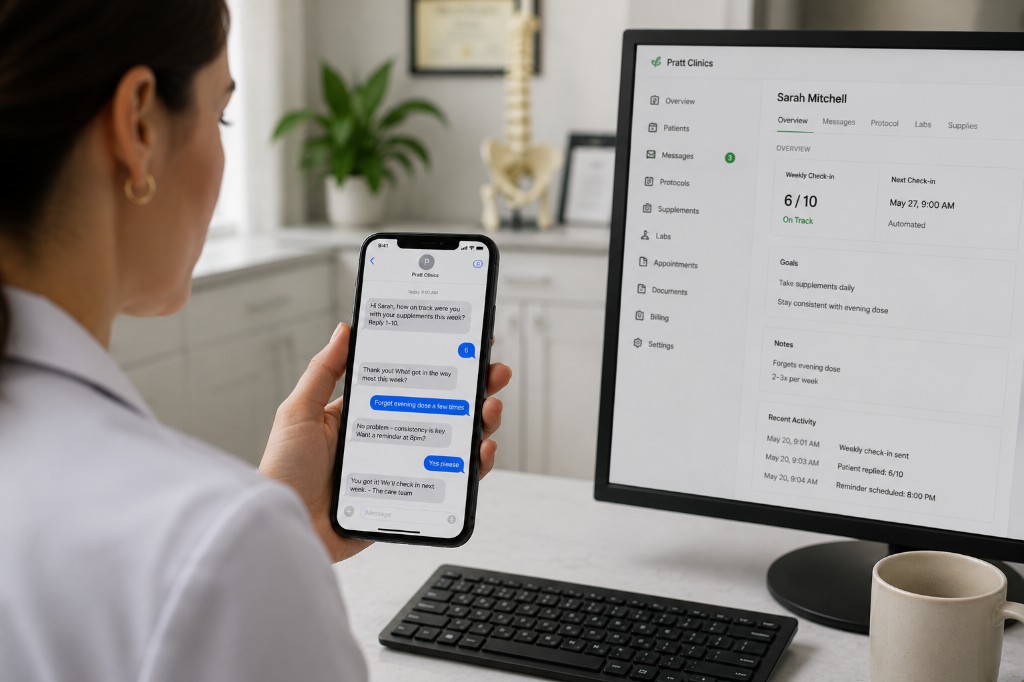
A clinic does not need an AI chatbot to automate patient follow-up.
Most follow-up is much simpler than that.
Send a welcome message.
Check in a week later.
Ask if the patient is running low.
Remind them about something that is already part of the plan.
Those messages do not need to be invented in real time.
They can be written once, approved by the clinic, and sent on schedule.
That is still automation.
Automate the repetitive part
A lot of between-visit work is predictable.
Someone starts a new protocol.
A week passes.
A supplement bottle gets closer to empty.
An appointment gets closer.
Those moments happen over and over again.
There is no reason a coordinator should have to remember each one manually.
The clinic can decide:
What should be sent.
When it should be sent.
Who should receive it.
Then the system handles the timing.
The message does not need to be generated by AI
This is where a lot of healthcare automation gets overcomplicated.
You do not need a model deciding what to say to a patient every Tuesday morning.
The clinic can write the message itself.
For example:
“How are you doing with the plan this week?”
or:
“Getting low on anything?”
That exact message can go out when it is supposed to.
No rewriting.
No improvising.
No chatbot trying to sound like the physician.
The patient gets the message the clinic actually approved.
Humans should still handle the replies that matter
Automation is great at starting routine conversations.
It is much less useful when the conversation stops being routine.
A patient might reply:
“Doing great.”
That probably does not need much attention.
Another might say:
“I stopped taking one of them.”
or:
“I think this is making me feel worse.”
Now a person should be involved.
The system does not need to diagnose anything.
Its job is to surface the reply to the right person.
That is a much cleaner line.
Automate the repetitive question.
Keep clinical judgment with the clinic.
This can save a surprising amount of staff time
Think about how many tiny follow-up tasks happen every week.
Send the check-in.
Remember who is due for a refill.
Follow up with the patient who never answered.
Send the same link again.
None of those tasks are individually difficult.
They just add up.
And because they are easy to postpone, they are often the first things to disappear on a busy day.
Automation makes the routine happen even when the front desk is slammed.
Staff can then spend their time on the patients who actually need help.
Not every message should be automated
There are obvious limits.
A system should not be making treatment decisions.
It should not be changing medications.
It should not be answering open-ended clinical questions on its own.
And it should not pretend to be the doctor.
There is a big difference between:
“Just checking in — how are things going?”
and an automated system deciding what the patient should do next.
The first is follow-up.
The second requires judgment.
The patient experience should still feel normal
Patients do not need to know or care that a message was scheduled.
They should just see a normal message from the clinic.
They can reply like they normally would.
If they need a person, someone from the clinic can step in.
That is the goal.
The automation stays in the background.
The relationship stays between the patient and the clinic.
Start with the messages your staff already repeats
You do not need to automate everything at once.
Look at what your team already sends over and over.
The welcome message.
The weekly check-in.
The running-low reminder.
The pre-visit message.
Write those well.
Approve them.
Choose the timing.
Then let the routine happen automatically.
You can add more later if it actually helps.
Good automation should feel boring
That is probably the best test.
The useful kind of automation in a clinic is not flashy.
It does not need to have a conversation about someone’s diagnosis at 9 p.m.
It just makes sure the small things happen when they are supposed to.
The patient gets checked on.
The refill reminder goes out before the bottle is empty.
Staff see the replies that matter.
And nobody has to remember to type the same message every Tuesday.
Common questions
- Can clinics automate patient follow-up without an AI chatbot?
- Yes. Write the message once, approve it, and send it on schedule. Welcome texts, weekly check-ins, and running-low reminders do not need to be invented in real time.
- What should still stay with staff?
- Replies that need judgment: someone stopped a supplement, feels worse, or asks an open-ended clinical question. Automate the repetitive question. Keep clinical judgment with the clinic.
- What should clinics automate first?
- The messages staff already repeat: welcome, weekly check-in, running-low reminder, and pre-visit. Write them well, approve them, choose the timing, then let the routine run.
- Will patients know the message was automated?
- They should not need to. They see a normal message from the clinic, reply normally, and get a person when they need one. Automation stays in the background.
We cite public sources in the text where it matters. For operations and finance context only, not clinical, legal, or investment advice.
Keep reading
Habit
Habit check-in texts: keep patients on the plan between visits
Clinic-approved welcome, weekly check-in, and running-low texts on a schedule. Patients reply in the same thread. Staff step in when someone needs a person.
· 4 min read
Patient texting
Automated patient texting for clinics: check-ins and refills without the busywork
Automate welcome texts, weekly check-ins, and running-low reminders with clinic-approved copy. Patients reply by text. Staff step in when someone needs a person.
· 4 min read
Patient engagement
Patient portals vs. clinic texting
Portals are good for labs, forms, and records. Weekly check-ins are a different job. When texting fits between visits, and how portals and text threads work together.
· 5 min read
See it on your patients.
Two weeks free on your real patients. Habit texts on a Helose-issued number. Patients reply on iMessage.